The Difference Between Pink and Black

As much as I’d love to tell you that I am a pro in this whole writing thing, here is the truth: I am but a beginner. It’s now been a bit over a year since I ‘decided’ to go into this business, if we count the very first word I typed into the file that eventually became my first book.

Now, having independently published two books, I can do a comparison between them. Not the stories, of course, how can a parent ever compare their children? But the methods I used and the result of such methods.

If I’m not a pro, then why bother writing these down? The answer is: I’m doing this for my future self. By writing these things down, hopefully my future self will remember that I did learn something, even if it feels like nothing comes out of it.

If you are also a beginner, or you haven’t even started, and you happen to come across this post & learn something new, then I’d be glad to know that this writing also helps someone else. It’s a win-win situation. 😉

First things first: I started out with nothing but my own manuscript and a handful of trusted people from whom I asked for advice. I had no social media account for the book purposes, and only made one a few weeks before the launching of my first book. One might say this was my first mistake, and maybe one is right.

It would definitely help my book’s marketing if I already had an effective social media account with thousands of followers. But we’re not here to speculate & I’m merely stating the facts. The fact is, I didn’t have it then.

So what happened when I started posting about the launch of my first book in the brand-new social media account?

Nothing.

I had no followers, no likes, and no posts that could pull anyone to become a reader.

For the record, my social media account’s handle used to be the name of my first book. I had (and still have) no pictures of myself, no selfies. Could this also add to the problem? Maybe.

So my socializing attempt was a flop. My book launch was a flop, too. The (low) sales were all made by my family members & friends, which was of course very nice of them, but when it came to getting reviews–I’m sorry to say–it’s pretty much non-existent. And we all know how important reviews are for an independent/self-publishing author.

And they really are important, the reviews. But even with low sales and even lower number of reviews, I decided to keep it ‘organic’ and not ask for anyone to read my book just for the sake of getting the reviews.

Having my book listed in the Kindle Unlimited gave me the opportunity to put my e-book up for Countdown & Free promotions. So I used the Countdown promo 5 months after the launch of my first book, making my e-book cost 99 cents for 72 hours. By this time, I had about 100+ followers on my social media account.

This proved to be a flop, too, and brought in only 1 sale.

Soon after, I changed the handle of my social media account to be my author name. I still don’t post any selfie there, but changing the handle made the account feel more human, and I felt like I had more freedom to post things unrelated to my first book (but related to writing in general). And since at that point I was writing my second book, it seemed natural to change it.

About 2,5 months since the Countdown promo, I decided to try the Free promo.

Needless to say, this time it was a success compared to the Countdown one. This was the first time I realized that my first book was actually interesting enough for people–other than my friends & family–to want to read, if only they didn’t need to pay for it. Which makes perfect sense, because, hello? Who am I again in the writing world?

This lifted my mood and I did it again as soon as I had my next chance, and finally, after several times of the Free promo, the reviews from new readers–people I did not know prior to writing/selling the book–started to pour in.

So yes, this experience made me learn that I shouldn’t be stingy when it comes to letting people read my book. I should forget all about the money, because the truth is, when someone is just starting out (the indie/self-pub way), no one would’ve heard about him/her. I don’t mean I should sell myself short, no, of course not. But spreading my work and finding my readers/market is more important than making money.

The reviews for my first book kept alive my will to write, and as I was finishing my second book’s manuscript, I decided it was time for me to try another method: asking people to beta read my second book.

As mentioned before, I didn’t have anything but my manuscript for my first book. This time around, though, I had about 300+ followers on my social media account, and a few fellow indie/self-pub authors that I felt comfortable sharing my second manuscript with. Some of them have read my first book and gave it good reviews, so I felt 80% sure that they would ‘get’ my second book (and maybe even like it–that’d be a great bonus). I asked them nicely and when they said yes, I prepared a list of things I wanted them to especially pay attention to when reading the manuscript.

Out of 5 beta readers (I still kept it to a minimum number), 3 gave me outstanding feedback, 1 didn’t really like it, and 1 never came back to me with any feedback. It was enough for me to go forward, so as a cherry on top, I asked the ones who did gave me their feedback if they’d be willing to write short endorsements. Some of them agreed and their endorsements are now at the back cover of my second book.

Not long after that, I published my second book, and instantly gained 4 first reviews from my beta readers. I did not ask them to do it, but I was blessed with such kind-hearted beta readers.

During the launch of my second book, I also had a giveaway contest to allure people to enter to win my second book. I would’ve thought the ‘free book’ words would win people over, but I was wrong again, for a good reason: the people who would actually read my book preferred to buy my book rather than enter my giveaway contest! 😅 That was a nice surprise!

I did still get enough entries in the end, and 4 people were given my second book for free. Out of these, 3 gave reviews (again, because they wanted to).

Now, 3 months has passed since my second book was launched and the sales number are somewhat similar to my first book’s first 3 months’ sale… but guess what? I don’t even know most of the buyers. 😁 With my first book, I knew exactly who bought them, because they were my family members & friends. Now, I can’t even tell who has bought my second book until suddenly a new review comes up.

While sales are still slow, I have to admit that using the help of beta readers was a good decision for me, even if it’s ‘only’ to get reviews. As of date, I have gotten more reviews for my second book in half the time it took for my first book to get 6 reviews.

Let’s face it, without having thousands of followers in social media and going through the traditional publishing or paying for a professional advertisement/marketing service, sales will probably always be slow and low. To tell the truth, I didn’t even expect to sell any book for my second one, except for (again) my immediate family members.

But I proved myself wrong, and that made me so happy.

And, let me remind you again: everything I’ve done for my book so far have been for free. I have not paid anyone or any party for anything at all.

I have no plans yet for any Countdown or Free promo for my second book. The second book’s regular price is already cheaper than the first one, which is one of the reasons why I’m still thinking about it. But who knows? Remembering I shouldn’t be stingy about spreading my work, I probably will end up doing it one day.

Thank you for reading this long post. ❤ My journey in the writing world & my books’ journeys shall continue no matter what, and if you’re also an indie/self-pub author, hopefully your journey continues after reading this.

To read the reviews of my books on Goodreads or leave your review (yay!), click here.

To purchase my book(s), click here.

Covering the Covers, Part 2

And I’m back to talk about the behind-the-scenes of making my book covers!

If you haven’t known it already, my second book that was supposed to be suspense and dark drama turned out to be yet another psychological thriller (I promise I didn’t know the genre until after I sent out the manuscript to my beta readers… more on this on my next posts!). So the same rule I used for my first novel–no person/silhouette of a person running/walking away from the reader on the cover–applies here, too.

At first, I was thinking of using a picture taken by my late brother-in-law. He was a talented photographer with an eye for raw and ‘just as you are’ scenes, who mostly took monochromatic pictures of Jakarta and its people, and he usually developed his own films, too.

Since my second book, The Invisible Ones, is set in Jakarta and Bandung, it would’ve otherwise been so perfect.

But as the writing progressed and the title came up (the book title always comes up at the latest stage for me), it was clear to me that I wanted a different approach.

For a moment, I even thought of just putting the title on the cover & that’s it. No images, no pictures, done. Imagine how eye-catching that would be, ha!

But I couldn’t do it. This ‘immaterialized’ book begged for a cover with something else, I had resolved to do it, so do it I shall!

I started doodling again on my trusted notebook. This time, I knew what color palette I was going for (monochrome plus blood red), but putting together a picture would consume too much time and energy… and I’m not even a good photographer.

That means I had to use my other hobby: drawing. I was thinking I could choose several items/events in the book that are significant, and put images of those in the cover. But when my husband saw it, he thought it reminded him too much of Ozark, so I didn’t go through with it.

And then I started thinking of symbols. Things that go on in the book, but put in a way that’s not too obvious. The first thing that came to mind was an onion, because of the way the female main character of my book tells her story. We’re peeling layer upon layer of her story until we get to the very core of herself as we move on throughout the book.

But as I thought of the layout of the book cover, imagined it with an onion at the center, it made me think of a recipe book instead. And that wasn’t a good idea. How could I make it work? I figured I needed to look around for ideas. How do other book cover designers/illustrators illustrate book covers in a not too-obvious way? How do they decide what to show on the cover?

While I went through other authors’ gorgeous book covers to search for ideas, I suddenly got reminded of my other past-life obsession: tarot cards.

Ever since I was a teenager & got my first tarot card deck, I had always dreamed of making my own deck. I was intrigued by the many hidden symbols in one single card, when I finally got the meaning of one thing it was like decoding a secret world.

It suddenly clicked in my head that that was what I was gonna go for. Make my book cover look like a tarot card, with all kinds of symbols for everything that goes on in the book. When the readers decode it (and I hope they do), I imagine giving them the same satisfaction as I got from decoding tarot cards.

Since the story takes place in Indonesia, I wanted to make all the symbols and style distinctly Indonesian, or even more specifically, Javanese. What would be better than Javanese batik and wood carving style?

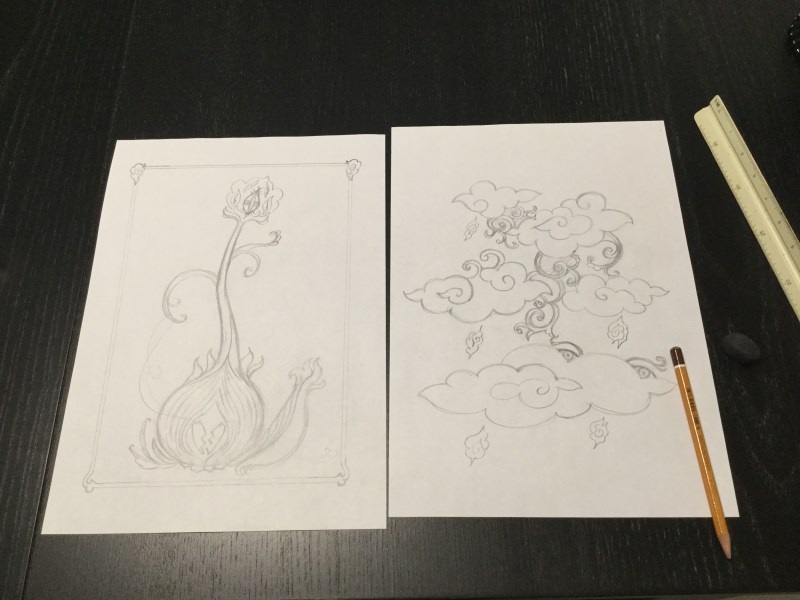
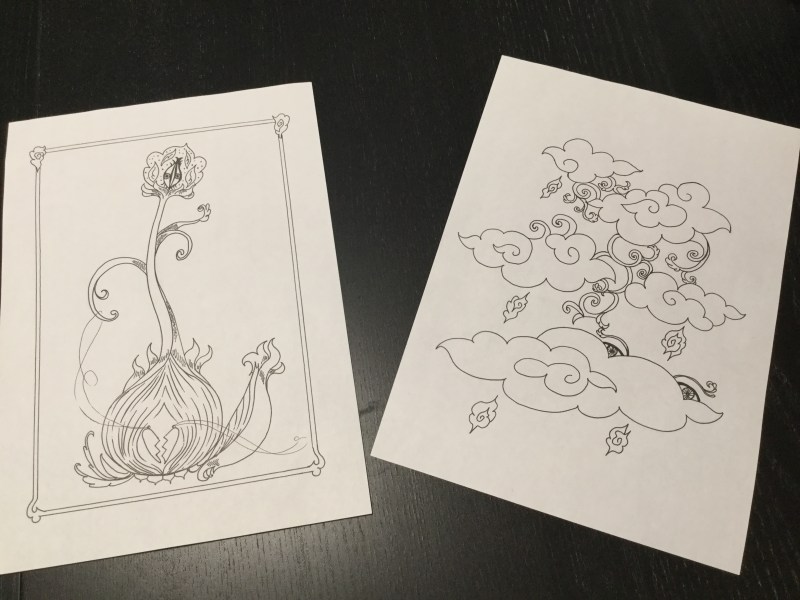
The ‘two of everything’ continues all the way to the cover. Each main character deserves their own illustration, so I made 2 separate ones to be combined in the end.

The bulb and flower for Maya, the clouds and rain for Indra, my other main character.

The clouds are drawn in the style of Indonesian batik pattern called ‘Megamendung’. I can’t even begin to tell you how these clouds depict Indra so well (other than the fact that his name means ‘god of lightning & rain’), so you can google the meaning of the pattern if you’d like.

Maya’s is the onion, as per my original idea, drawn also in the same style of Javanese batik.

I used licensed Photoshop for commercial use again to edit the illustrations.

This time, I wanted the font not to only tell readers/viewers what the title of my book is, but to also show it. I chose a font that has multiple thickness to create a sense of invisibility to the ‘invisible’ word.

In general, I like my book covers to have matte finishing. However, having a black book cover was something I never tried in matte finishing, and I was slightly worried about how it would look. This was where the author’s proof copy came in handy.

If you’re self-publishing a paperback, I highly recommend getting the author’s proof copy before you actually publish it. For me, it was great to see if all the tiny white outlines of my illustration were visible enough and to know just how dark black the book cover would look like in real life.

Once everything was done, it was time to publish the book!

Just like with my first book, I love my second book cover. It’s me, it’s perfect for my story, and it’s something I won’t be embarrassed about no matter how long I see into the future.

If you’ve read my book, how many symbols have you found in the illustration that you could make out from the book? Remember, everything means something there in the book and on the cover design. Nothing means nothing.

Covering the Covers, Part 1

Let’s talk about making book covers.

The good thing about being an independent (indie) and a self-publishing (self-pub) writer is that you get to prepare your own book covers. The bad thing about being an indie and self-pub writer is that you get to prepare your own book covers.

You either love doing it, or you don’t. Luckily, there are many book cover designers that you can hire to do your book cover these days, but as I haven’t used any, I’m here to talk about the other option: making it yourself.

I am merely writing this down to record my own experience and journey, and in no way I am saying that this is what one should or shouldn’t do. If you are a fellow indie/self-pub writer, at the end of the day you’ll realize that you’ll find your own voice and ways to do things.

Though the appeal of using ready-stock images and easy-to-use image editing apps may be calling, for my previous book and the coming one I used the old-fashioned ways. I took the pictures myself or I drew things by hand and used a ‘licensed for commercial use’ program to make them. One might argue that such licensed programs are expensive and since we don’t even know yet if one would make profits from the book itself, why pay that much? Well, I can tell you one thing: some things are worth investing in. If something can put an ease to my mind for not having anyone claim that I stole their photo/illustration some time in the future, then by all means, sign me up!

To be honest, the main reason why I do this the old-fashioned way is because I do judge a book by its cover. In my humble opinion, when one uses ready-stock images or easy-to-use image editing apps, there’s always a risk that the book cover in question would end up looking similar to others’. If I only have one shot to catch a possible reader’s attention, I’d want my book cover to be different than others.

So the first thing I did when designing my very first book cover was to decide what I didn’t want. Psychological thriller/mystery books often have a person on the cover, with his/her back facing the viewer, usually either a person that looks like a detective or the ‘victim’ running away to the dark. Have you ever noticed this? I have. And speaking of dark, dark colors are used immensely as well. Early on in the days of my designing my book cover, I knew that I didn’t want any of these.

By this time, I already knew the title of my book (FYI, it’s not strange for me to not have a title until the very last moment) so for my first book, that was what I looked at next, and took quite a literal translation to it.

early sketch for the cover

Of course it was only natural that I had to have sugar on the cover of my first book, Sweet Like Sugar. Sugar was, after all, the coating of everything in that story. But underneath the sugar lies something dark, so I had it photographed on top of a black plate, with just a tiny bit of black lurking from beneath it.

just white sugar on a black plate

As seen from my sketches, I didn’t plan on having a hand print on the cover. But as I was trying to get the right kind of surface, playing with all the sugar with my bare hands, the idea started to form in my head.

hmm, kind of cool

After taking dozens of the same shots, I decided to develop both ideas and see which one came out better.

I don’t know about you, but I liked the hand print better! And yet, something is still not quite right. It wasn’t until I played with the saturation that it dawned on me: the color had to be something else than white.

You know that feeling of craving for something sweet, and then you finally get to eat a whole lot of that sweetness until you get so sick from it? Sickeningly sweet. That was what I wanted it to be. That was what I wanted the book cover to ‘taste’ like.

voila!

And that was how I got to this end result.

To others, it probably doesn’t seem like it was a lot of work, but I did spend a considerable amount of my time for it. Maybe I was just too slow, but I am still damn proud of my first book cover. It has the right amount of eye-catchiness, the right amount of sweetness, and the right amount of unsettling darkness.