And I’m back to talk about the behind-the-scenes of making my book covers!
If you haven’t known it already, my second book that was supposed to be suspense and dark drama turned out to be yet another psychological thriller (I promise I didn’t know the genre until after I sent out the manuscript to my beta readers… more on this on my next posts!). So the same rule I used for my first novel–no person/silhouette of a person running/walking away from the reader on the cover–applies here, too.
At first, I was thinking of using a picture taken by my late brother-in-law. He was a talented photographer with an eye for raw and ‘just as you are’ scenes, who mostly took monochromatic pictures of Jakarta and its people, and he usually developed his own films, too.
Since my second book, The Invisible Ones, is set in Jakarta and Bandung, it would’ve otherwise been so perfect.
But as the writing progressed and the title came up (the book title always comes up at the latest stage for me), it was clear to me that I wanted a different approach.
For a moment, I even thought of just putting the title on the cover & that’s it. No images, no pictures, done. Imagine how eye-catching that would be, ha!
But I couldn’t do it. This ‘immaterialized’ book begged for a cover with something else, I had resolved to do it, so do it I shall!
I started doodling again on my trusted notebook. This time, I knew what color palette I was going for (monochrome plus blood red), but putting together a picture would consume too much time and energy… and I’m not even a good photographer.
That means I had to use my other hobby: drawing. I was thinking I could choose several items/events in the book that are significant, and put images of those in the cover. But when my husband saw it, he thought it reminded him too much of Ozark, so I didn’t go through with it.

And then I started thinking of symbols. Things that go on in the book, but put in a way that’s not too obvious. The first thing that came to mind was an onion, because of the way the female main character of my book tells her story. We’re peeling layer upon layer of her story until we get to the very core of herself as we move on throughout the book.
But as I thought of the layout of the book cover, imagined it with an onion at the center, it made me think of a recipe book instead. And that wasn’t a good idea. How could I make it work? I figured I needed to look around for ideas. How do other book cover designers/illustrators illustrate book covers in a not too-obvious way? How do they decide what to show on the cover?
While I went through other authors’ gorgeous book covers to search for ideas, I suddenly got reminded of my other past-life obsession: tarot cards.
Ever since I was a teenager & got my first tarot card deck, I had always dreamed of making my own deck. I was intrigued by the many hidden symbols in one single card, when I finally got the meaning of one thing it was like decoding a secret world.
It suddenly clicked in my head that that was what I was gonna go for. Make my book cover look like a tarot card, with all kinds of symbols for everything that goes on in the book. When the readers decode it (and I hope they do), I imagine giving them the same satisfaction as I got from decoding tarot cards.
Since the story takes place in Indonesia, I wanted to make all the symbols and style distinctly Indonesian, or even more specifically, Javanese. What would be better than Javanese batik and wood carving style?
The ‘two of everything’ continues all the way to the cover. Each main character deserves their own illustration, so I made 2 separate ones to be combined in the end.
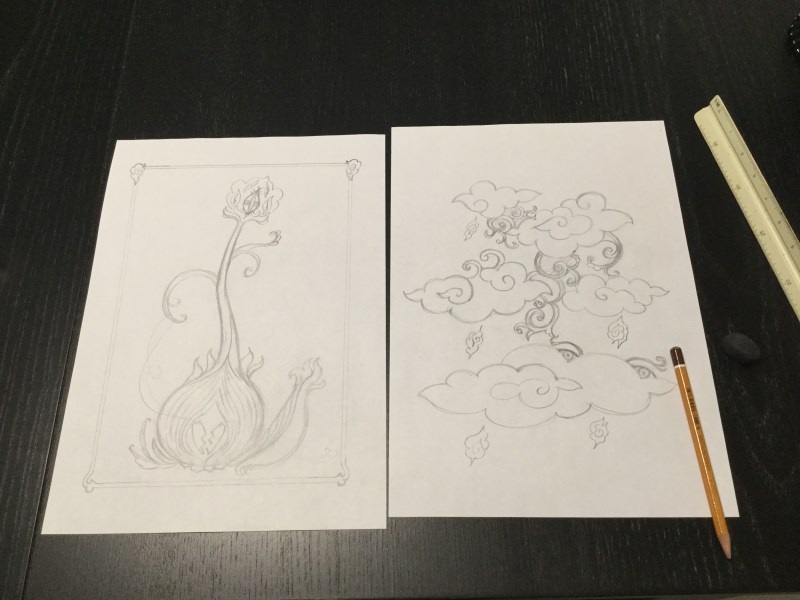
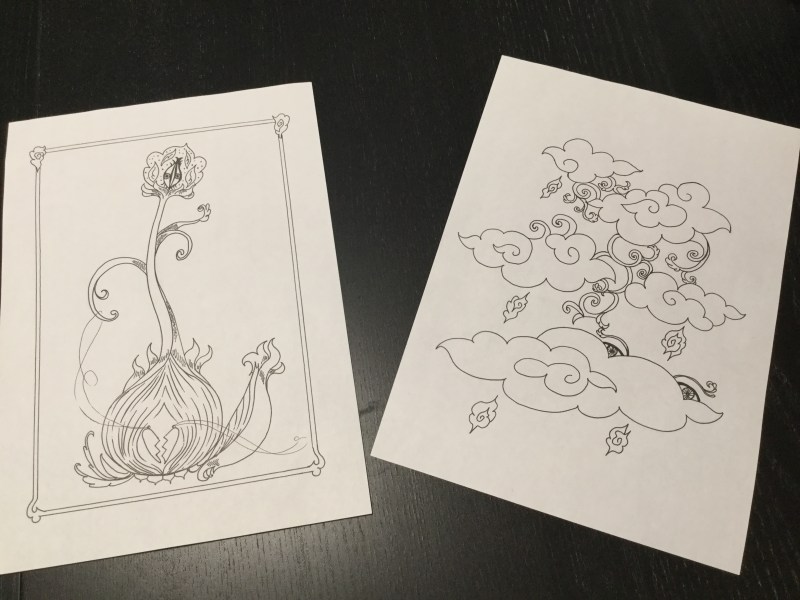
The bulb and flower for Maya, the clouds and rain for Indra, my other main character.
The clouds are drawn in the style of Indonesian batik pattern called ‘Megamendung’. I can’t even begin to tell you how these clouds depict Indra so well (other than the fact that his name means ‘god of lightning & rain’), so you can google the meaning of the pattern if you’d like.
Maya’s is the onion, as per my original idea, drawn also in the same style of Javanese batik.
I used licensed Photoshop for commercial use again to edit the illustrations.
This time, I wanted the font not to only tell readers/viewers what the title of my book is, but to also show it. I chose a font that has multiple thickness to create a sense of invisibility to the ‘invisible’ word.
In general, I like my book covers to have matte finishing. However, having a black book cover was something I never tried in matte finishing, and I was slightly worried about how it would look. This was where the author’s proof copy came in handy.
If you’re self-publishing a paperback, I highly recommend getting the author’s proof copy before you actually publish it. For me, it was great to see if all the tiny white outlines of my illustration were visible enough and to know just how dark black the book cover would look like in real life.
Once everything was done, it was time to publish the book!
Just like with my first book, I love my second book cover. It’s me, it’s perfect for my story, and it’s something I won’t be embarrassed about no matter how long I see into the future.
If you’ve read my book, how many symbols have you found in the illustration that you could make out from the book? Remember, everything means something there in the book and on the cover design. Nothing means nothing.
 Author D. P. Haka